GLP-1 receptor agonists — semaglutide (Ozempic®, Wegovy®) and tirzepatide (Mounjaro®, Zepbound®) among them — have become best known for two things: meaningful weight loss and better blood sugar control. But as more people use these medications long-term, researchers are starting to ask a bigger question: what else might happen in the body when insulin sensitivity improves, visceral fat drops, and chronic inflammation eases? One area getting growing attention is cancer biology — not as a treatment claim, but as a window into how metabolic health and cancer risk are connected.
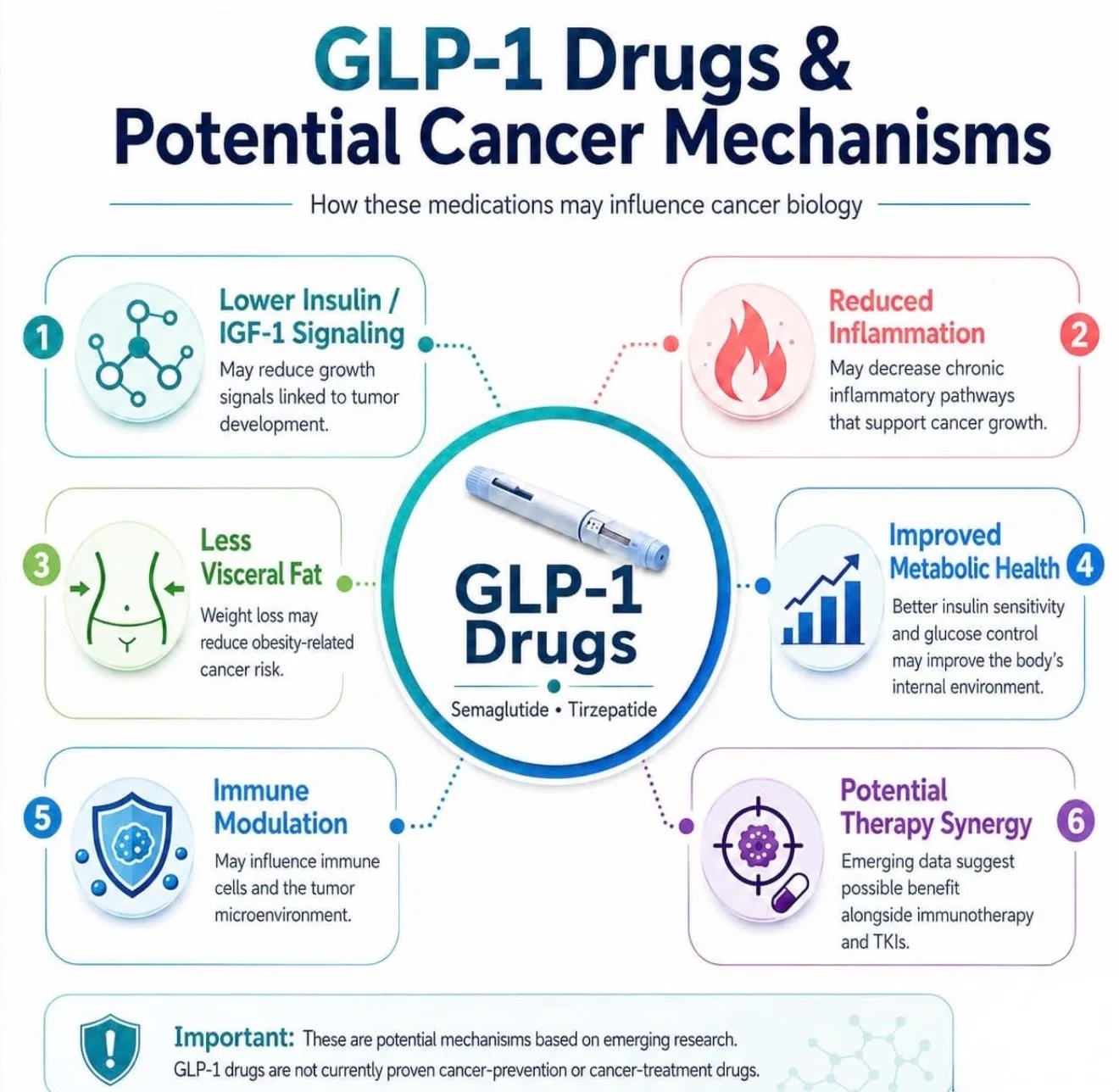
The graphic above summarizes six mechanisms researchers are currently studying. None of these represent a proven cancer-prevention or cancer-treatment effect — they're plausible biological pathways based on what's already understood about metabolism, inflammation, and tumor growth in general.
The six mechanisms researchers are studying
1. Lower insulin / IGF-1 signaling
Chronically elevated insulin and IGF-1 are linked to growth-signaling pathways that some tumors rely on. By improving insulin sensitivity, GLP-1 drugs may reduce this signaling over time.
2. Reduced inflammation
Chronic low-grade inflammation is a hallmark of many cancer-promoting environments. Weight loss and improved metabolic markers are associated with lower inflammatory markers like hsCRP.
3. Less visceral fat
Visceral (abdominal) fat is independently associated with increased risk for several cancer types. Significant fat loss — particularly visceral fat — may help reduce that baseline risk.
4. Improved metabolic health
Better glucose control, insulin sensitivity, and lipid profiles all contribute to a healthier internal environment — one that's generally less favorable to abnormal cell growth.
5. Immune modulation
Early research suggests GLP-1 drugs may influence immune cell behavior and the tumor microenvironment, though this area is still in the early stages of study.
6. Potential therapy synergy
Some emerging data is exploring whether GLP-1 therapy alongside immunotherapy or targeted treatments (TKIs) could offer additive benefit — an active area of ongoing research.
Important: These are potential mechanisms based on emerging research, not established outcomes. GLP-1 drugs are not currently proven cancer-prevention or cancer-treatment medications, and no one should start or adjust a GLP-1 medication based on cancer-related expectations. Speak with your physician about the evidence-based reasons for these medications — primarily weight management and metabolic health — and let any additional benefits be a bonus, not the goal.
Why this matters for how we approach weight loss
At BioVella, our medical weight loss program was never just about a number on the scale. The same biomarkers researchers are studying in this context — insulin, inflammation markers like hsCRP, glucose, lipid panels — are exactly what we track for every patient on a GLP-1 protocol. Understanding how your metabolic health is trending gives you (and your physician) a much more complete picture than weight alone.
If you're curious whether a GLP-1 program — or a broader look at your metabolic baseline — makes sense for you, our self-assessment is a good place to start.